
 EN
EN FR
FR 中文
中文 ES
ES PT
PT عربي
عربي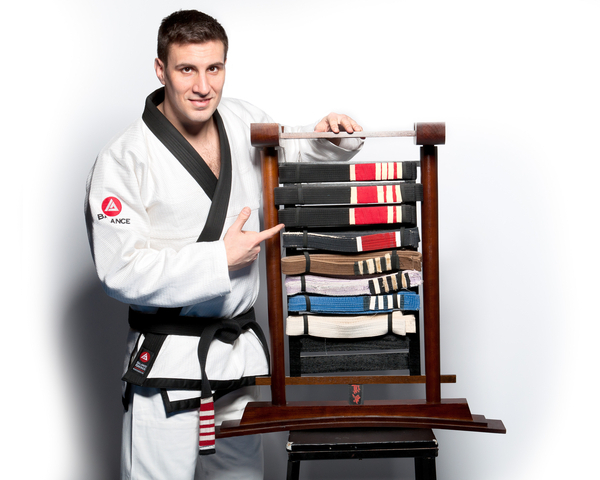
The Road Map You Didn't Know You Needed
You just watched a purple belt casually dismantle someone twice their size. Smooth, effortless, almost lazy. Then you looked down at your own white belt and thought: "How long until I can do that?"
That question is going to haunt you - in the best way. Because a BJJ black belt takes an average of 10-15 years. That's not a typo. Unlike karate, where a dedicated student might earn a black belt in 3-4 years, jiu-jitsu makes you earn every inch of colored fabric around your waist. No shortcuts, no belt factories, no paying your way to the next rank.
But that difficulty is exactly what makes the system addictive. Every stripe, every belt feels like it means something - because it does. This guide covers everything: what each belt represents, how long it typically takes, the stripe system, kids belts, and how promotion works at Gracie Laval.
The Adult Belt System
The IBJJF (International Brazilian Jiu-Jitsu Federation) recognizes the following adult belt progression:
White Belt - The Beginning
Typical duration: 1-2 years
Every single person who has ever earned a black belt in BJJ started here. The white belt is not a sign of incompetence - it's a badge of courage. You showed up. You started.
What you'll learn at white belt:
- Survival - how to defend yourself from common positions
- Basic positions - guard, mount, side control, back control
- Fundamental submissions - armbar, triangle, rear-naked choke, kimura
- Escapes - getting out from under mount, escaping side control, defending submissions
- Movement - hip escapes (shrimping), bridging, technical stand-ups
The white belt phase is the steepest learning curve you'll experience. Everything is new. You'll feel lost, confused, and occasionally frustrated. This is universal. Every black belt you've ever admired went through exactly this.
"The white belt is not about knowing techniques. It's about learning how to learn." - Professor Louis-Philippe, Gracie Laval
Blue Belt - The First Milestone
Typical duration at blue belt: 2-3 years
Minimum age: 16 (IBJJF)
The blue belt is the first major milestone and, statistically, where the most students quit. The initial excitement fades, progress feels slower, and the gap between you and upper belts feels enormous.
What changes at blue belt:
- You have a solid defensive game - upper belts can't submit you easily anymore
- You start developing a personal game - positions and submissions that suit your body type
- You understand timing and when to move versus when to wait
- You can roll with new white belts and control the pace without hurting them
The blue belt is also where many people experience the "blue belt blues" - a plateau where you feel like you're not improving. This is an illusion. Your standards are simply rising faster than your skills, which actually means you're developing better awareness.
Purple Belt - The Student Becomes a Teacher
Typical duration at purple belt: 1.5-3 years
Minimum age: 16 (IBJJF)
Purple belt is where BJJ gets fun. Your technique is refined enough that you start creating your own combinations and transitions. You see opportunities others don't. You can explain techniques to lower belts clearly, which is why many purple belts begin assisting with instruction.
What defines a purple belt:
- Creativity - you combine techniques in ways unique to your game
- Efficiency - you use less energy, more leverage, more timing
- Teaching ability - you can break down and communicate concepts
- Adaptability - you have answers for most common positions and can improvise for the rest
Many martial artists consider purple belt the "fun belt" because the struggle of survival is behind you and the pressure of mastery hasn't arrived yet. You're in the sweet spot.
Brown Belt - Refining the Details
Typical duration at brown belt: 1-2 years
Minimum age: 18 (IBJJF)
Brown belt is the polishing phase. The broad strokes of your game are established. Now you're refining details - the angle of your grip, the timing of your hip movement, the precise moment to execute a sweep.
What makes a brown belt:
- No obvious holes in their game - they can play from any position
- Precision - techniques are sharp, economical, and effective
- Composure - nothing surprises them on the mat
- Mentorship - many brown belts are actively teaching classes
Brown belts are often described as "black belts in training," and at most academies, the difference between a brown belt and a black belt is more about time and maturity than technique.
Black Belt - Mastery and Responsibility
Minimum time from white to black: 8-10 years (most take 10-15)
Minimum age: 19 (IBJJF)
The black belt in BJJ represents something different from most martial arts. It's not just technical mastery - it's a recognition that you've dedicated a significant portion of your life to the art, that you can teach it, that you can represent it, and that you've given back to the community that raised you.
What a black belt represents:
- Complete technical knowledge of all major positions and submissions
- The ability to teach at every level, from day-one beginners to advanced competitors
- Character and leadership - a black belt is expected to set the standard for the gym
- Continued learning - black belt is not the end, it's a new beginning
Professor Louis-Philippe holds his Black Belt through direct lineage from Renzo Gracie via Team OAMA. His standards for promotion at Gracie Laval reflect this lineage - every belt earned here means something.
Beyond Black - Coral and Red Belts
After black belt, the IBJJF recognizes coral belts (7th and 8th degree) and the red belt (9th and 10th degree) - reserved for grandmasters with 30-50+ years in the art. You've likely never seen one in person.
Meet Our Instructors
World-class coaching from Black Belts with 15+ years of experience.
View InstructorsThe Stripe System
Between belt promotions, instructors award stripes - small pieces of tape wrapped around the belt. Each belt can have up to four stripes before the next belt promotion.
Stripes represent:
- Progress within a belt level - you're heading in the right direction
- Consistency - showing up matters as much as talent
- Technical growth - your instructor sees improvement in specific areas
- Attitude and contribution - how you train, how you help others, how you represent the gym
At Gracie Laval, Professor LP awards stripes based on a combination of technical knowledge, rolling ability, consistency, and attitude. There's no testing fee. There's no formal exam. When you're ready, you'll know - and so will your instructor.
Blue belt with 2 stripes earned, 2 remaining before purple belt promotion.
The Kids Belt System
Kids (under 16) follow a different belt progression with more colors to keep motivation high during the longer developmental years:
Kids belts in order:
White → Grey → Yellow → Orange → Green
Each kids belt also has stripe progressions, and the official IBJJF graduation system includes intermediate belt colors (grey-white, grey-black, etc.) to provide even more milestones.
At age 16, kids belts convert to the adult system. A child who has trained for years and earned a green belt will typically receive a blue belt when they transition - or may also receive a purple belt at the professor's discretion, recognizing their accumulated skill and experience.
The kids belt system works brilliantly for young practitioners because:
- Frequent milestones keep motivation high
- Visual progress (new belt colors) is tangible and exciting
- Goal-setting becomes a natural habit
- Delayed gratification is practiced in an age-appropriate way
How Advancement Actually Works
Unlike some martial arts where you show up to a testing day and perform a series of predetermined techniques, BJJ promotion is based on your instructor's holistic evaluation. There's no set curriculum you check off. Instead, promotion considers:
Technical knowledge:
- Do you understand the fundamental positions and submissions for your level?
- Can you demonstrate techniques cleanly?
- Do you have a personal game that works against resisting opponents?
Live rolling ability:
- How do you perform against partners of similar size and experience?
- Can you handle pressure from higher belts without panicking?
- Is your game effective, or just theoretical?
Consistency and mat time:
- How often do you train? Belt promotions require consistent time on the mat
- Have you been showing up long enough for your instructor to properly evaluate you?
Character and attitude:
- Do you help newer students?
- Do you train with control and respect?
- Do you represent the academy well?
There's no way to buy a belt promotion at Gracie Laval. Every stripe and every belt is earned through time, sweat, and dedication. That's what makes them worth wearing.
How BJJ Compares to Other Belt Systems
Karate uses many belt colors with formal kata testing and a 3-5 year path to black belt. Judo (Coach Mani at Gracie Laval holds a Judo Black Belt) takes 4-8 years, combining competition points with technical evaluation. Taekwondo features 8-10 belt steps with forms and board breaking, typically 2-4 years to black.
BJJ has just 5 adult belt colors - the fewest of any major martial art - with a 10-15 year path to black belt, the longest of any. Promotion is based on holistic instructor evaluation including live sparring performance. You cannot fake your way to a BJJ belt. Each one carries weight precisely because they're so difficult to earn.
Adults BJJ Program (14+)
Gi fundamentals, takedowns, and competition training. 5 classes per week.
Explore Adults ProgramThe Journey Metaphor (That Happens to Be True)
Everyone says "it's about the journey, not the destination." In BJJ, this cliche is literally accurate.
If you train only for belts, you'll quit at blue. The timeline is too long, the progress too subtle, and the plateaus too frequent to sustain motivation based on external rewards alone.
The people who make it to black belt - and beyond - are the ones who fell in love with the process. The daily practice. The small victories. The moment a technique clicks after months of failure. The friendships forged through shared struggle.
Your belt will change color over the years. The person wearing it will change more.
Start Your Journey
Every black belt started as a confused white belt who didn't know what "shrimping" meant. The only difference between them and someone who never started is that they walked through the door.
Your first class at Gracie Laval is free. You'll start at white belt - just like Professor LP did, just like every world champion did, just like everyone does.
The question isn't whether you're ready. The question is whether you're willing to begin.